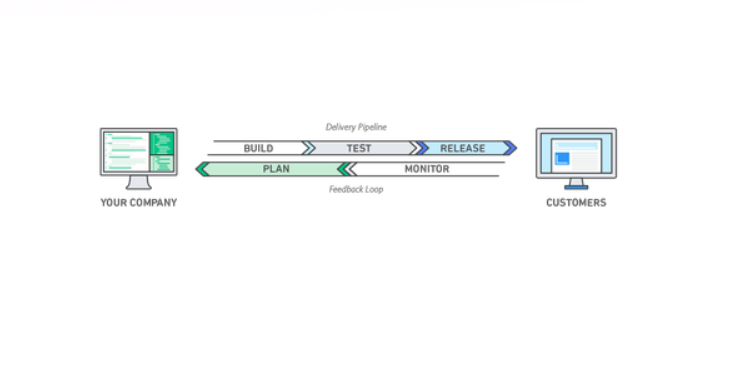
What Is DevOps? A Practical Guide Inspired by AWS
DevOps isn’t just a set of tools—it’s a culture and a way of building software that focuses on speed, reliability, collaboration, and continuous improvement.
According to AWS, DevOps combines cultural philosophies, engineering practices, and automation tools to help teams deliver applications faster and operate them more efficiently. In simpler terms: DevOps helps you ship faster, with fewer bugs, and with happier teams.
This article breaks down the core ideas of DevOps in a friendly, practical way.
🚀 Why DevOps Exists
Modern businesses rely on software for everything—from customer-facing apps to internal logistics systems. Because of this, companies must deliver updates faster than ever.
Traditional models separated “developers” and “operations,” causing slow handovers, bottlenecks, and production issues.
DevOps fixes this by:
- Bringing teams together
- Encouraging shared ownership
- Automating manual processes
- Ensuring faster, safer releases
The result? Teams innovate quicker and respond to customer needs faster.
🧠 How DevOps Works
In a DevOps model:
- Development and operations teams work together instead of in silos.
- Engineers participate in the entire lifecycle—from writing code to deploying and maintaining it.
- QA and security teams often integrate directly with DevOps teams (known as DevSecOps).
- Manual tasks (like deployments, infrastructure provisioning, testing) are automated, improving speed and reliability.
Automation + collaboration = higher velocity.
🌟 Benefits of DevOps
1. Speed
Teams can innovate faster and respond quicker to market shifts.
Microservices and CI/CD help teams deploy updates rapidly.
2. Rapid Delivery
Frequent releases mean bugs get fixed quickly and new features reach customers sooner.
3. Reliability
Practices like CI/CD ensure each change is tested and safe.
Monitoring helps teams detect issues early.
4. Scale
Automation and Infrastructure as Code help manage large, complex systems.
5. Collaboration
Shared responsibilities reduce friction and create stronger, more efficient teams.
6. Security
Automation helps enforce compliance, track changes, and ensure secure configurations—without slowing teams down.
🏗️ DevOps Cultural Philosophy
Adopting DevOps begins with a mindset shift:
- Break down silos
- Encourage open communication
- Promote shared ownership
- Think beyond your role
- Focus on the end user’s needs
DevOps isn’t a toolset—it’s a culture.
🔧 Core DevOps Practices
Here are the essential practices AWS outlines:
1. Continuous Integration (CI)
CI means merging code frequently into a shared repository where automated tests run immediately.
Benefits:
- Catch bugs faster
- Reduce integration issues
- Improve software quality
2. Continuous Delivery (CD)
CD extends CI by automatically preparing builds for release.
With proper CD:
- Every change is tested
- Every build is deployable
- Releases become routine, not stressful
3. Microservices Architecture
Microservices break applications into small, independent services.
Advantages:
- Faster deployments
- Smaller teams can own individual services
- Reduced coordination overhead
This architecture pairs extremely well with DevOps practices.
4. Infrastructure as Code (IaC)
Infrastructure is provisioned using code instead of manual steps.
Benefits:
- Consistency
- Version control
- Repeatable deployments
- Faster environment setup
Tools like AWS CloudFormation or Terraform make IaC standard today.
5. Configuration Management
Automating OS-level and server-level configuration ensures consistent, repeatable deployments.
Example tools:
- AWS Systems Manager
- AWS OpsWorks
6. Policy as Code
Compliance rules are defined and enforced automatically.
This helps teams:
- Detect violations instantly
- Remediate issues automatically
- Keep speed without compromising security
7. Monitoring and Logging
Monitoring metrics and logs allows teams to:
- Detect issues early
- Understand performance
- Maintain 24/7 availability
- Do real-time analysis
AWS CloudWatch and AWS CloudTrail are commonly used for this.
8. Communication and Collaboration
DevOps relies heavily on:
- Chat tools
- Issue trackers
- Wikis
- Automated notifications
These systems bring everyone onto the same page and reduce bottlenecks.
🧰 DevOps Tools on AWS
AWS provides a wide suite of DevOps-focused tools, including:
- AWS CodePipeline – CI/CD orchestration
- AWS CodeCommit – Git repository hosting
- AWS CodeBuild – Build and test automation
- AWS CodeDeploy – Automated deployments
- Amazon ECS/EKS – Container services
- AWS CloudFormation – Infrastructure as Code
- AWS CloudWatch – Monitoring & logging
- AWS Lambda – Serverless microservices
These tools help teams automate everything from code build to infrastructure provisioning.
🎯 Final Thoughts
DevOps isn’t just for big companies or cloud-native startups—it’s for any organization that wants to:
- Move faster
- Build more reliable software
- Streamline teamwork
- Improve quality
- Deliver customer value quickly
With the right combination of culture, tools, and automation, DevOps becomes a powerful advantage.
If you’re entering the world of cloud engineering or DevOps, understanding these foundations sets you up for long-term success.